
When Does an RIA Firm Need to File Form 13F with the SEC?
If your RIA manages $100 million or more in certain securities with discretion, you're probably required to file Form 13F with the SEC.
The thing is, many firms cross the threshold without realizing it…especially those who shifted from mutual funds to ETFs. (Mutual funds aren't reportable. ETFs are.)
That's a problem. The SEC actively enforces 13F requirements, and firms that fail to file, even unknowingly, can face significant penalties. "We didn't know" isn't a defense.
This guide will help you determine whether your firm is required to file and understand what it takes to stay compliant, so you can avoid the fines and headaches that come with getting it wrong.
Here's what we'll cover:
When the Form 13F filing obligation kicks in
What securities trigger reporting
Key deadlines to remember
What happens if you miss the deadline (and how to fix it)
When does the Form 13F requirement apply?
You must file Form 13F if you're an institutional investment manager deciding what to buy or sell and your Section 13(f) securities total $100 million or more.
Key point: The threshold is measured on the last trading day of any month, NOT quarterly. That means market gains or new client money can push you over the line faster than you expect.
Regardless of which month you cross the threshold, your first required filing is always Q4 of that calendar year. You are not required to file for any earlier quarters in the threshold year. You must then file for Q1, Q2, and Q3 of the following year – four filings total at minimum – even if your assets drop back below $100 million. (See SEC Form 13F FAQ for details.)
Example:
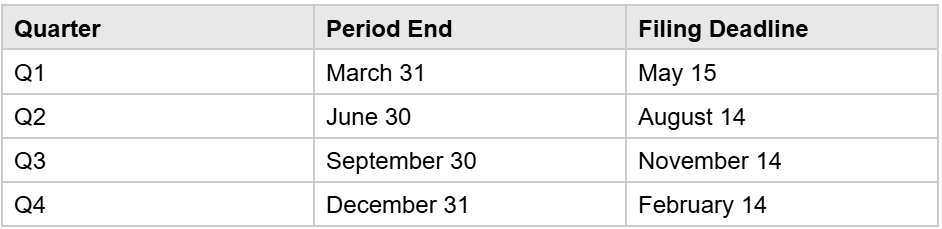
Your firm first crosses $100 million as of June 30, 2026. Even though you crossed mid-year, you are not require to file for Q2 or Q3 2026. Your first filing covers Q4 2026 (due February 14, 2027). You then file for Q1, Q2, and Q3 2027 – due May 15, August 14, and November 14, 2027. Four filings total, regardless of whether your assets remain above $100 million.
Related: Do You Qualify for Form 13F? Understanding the $100 Million Threshold
Who counts as an institutional investment manager?
The SEC defines an 'institutional investment manager' broadly: any entity that exercises investment discretion over securities accounts. That means having the power to decide which securities are bought or sold.
Common filer types:
Registered investment advisers (RIAs)
Hedge funds and private equity funds
Family offices with investment discretion
Bank trust departments
Insurance companies and pension funds
Broker-dealers managing discretionary accounts
This applies to both U.S.-based and foreign managers using U.S. mail or interstate commerce. You can read more in our full Form 13F FAQ.
What securities trigger 13F reporting?
Only Section 13(f) securities count toward the $100 million threshold and must be reported. The SEC publishes the Official List of Section 13(f) Securities quarterly. The current list contains over 20,000 securities.
Reportable (on the list):
U.S. exchange-traded stocks (NYSE, NASDAQ)
ETFs and ETNs – this is the big one for RIAs
Closed-end fund shares
Certain equity options and warrants
ADRs (American Depositary Receipts)
Convertible notes (if on the Official List)
Certain fixed-income securities
NOT reportable:
Mutual funds (open-end investment companies)
Short positions
Most fixed-income securities
Anything not on the Official List
What to check: Many RIAs moved from mutual funds to ETFs in recent years. Since mutual funds aren't 13(f) securities but ETFs and ETNs are, this shift has pushed many firms over the $100 million threshold without them realizing it.
Filing deadlines (what to remember)
Form 13F is due 45 calendar days after each quarter-end. If the deadline falls on a weekend or holiday, it rolls to the next business day.
What if you miss the deadline?
The SEC does not grant extensions. If you miss a deadline, file as soon as possible…don't wait for the next quarter.
Recent enforcement (September 2024): The SEC charged 11 institutional investment managers for failing to file. Penalties ranged from $175,000 to $725,000, totaling over $3.4 million.
Good news: Two firms in the same sweep paid zero penalties by self-reporting and cooperating. If you've missed filings, voluntary disclosure can significantly reduce (or eliminate) penalties.
Beyond fines, filing errors can damage your firm's reputation with clients and regulators. It's worth getting right the first time.
Other obligations for 13F filers
If you file Form 13F, you may also need:
Form N-PX – All 13F filers must report say-on-pay proxy votes annually. Due August 31. You must file even if you don't vote proxies. See our N-PX FAQ for 13F Filers.
Form 13H – For large traders (2M+ shares or $20M+ daily). Two firms in the 2024 sweep were also charged with 13H violations. See our Form 13H FAQ
Schedule 13G – If you beneficially own 5%+ of a public company's voting equity. See our Schedule 13G FAQ
Ready to hand off your 13F filings?
Determining your filing obligation, formatting holdings data for EDGAR, and hitting quarterly deadlines can take hours…especially if you're new to the process.
With ACN, you can:
Send us your holdings list and we’ll identify your 13F-reportable securities and calculate your threshold – free of charge
We format your holdings data and submit directly to EDGAR on your behalf
Quarterly deadlines, backfiling, and edge cases all handled
ACN has filed more Form 13Fs per quarter than any other agent since 1999. We handle the data transformation from raw custodian exports to filed XML – including edge cases other agents haven’t seen before. Contact us to get started
The information provided in this blog post is for general informational purposes only and does not constitute legal, compliance, or financial advice. ACN Solutions LLC is not a law firm, compliance advisor, or affiliated with the Securities and Exchange Commission (SEC). While we strive to provide accurate and timely guidance based on publicly available SEC resources, we do not speak on behalf of the SEC and are not authorized to interpret its rules or policies. Readers should consult their legal counsel or compliance professionals for specific guidance related to their regulatory obligations.”